
What Is the Current Phase of Moon Emoji?
The current phase of moon emoji refers to the lunar symbol that best represents the Moon’s appearance in the sky at a particular time. Moon emojis are popular across messaging apps, social media platforms, blogs, and digital calendars. They help people express nighttime moods, share astronomy facts, and decorate captions with celestial symbols.
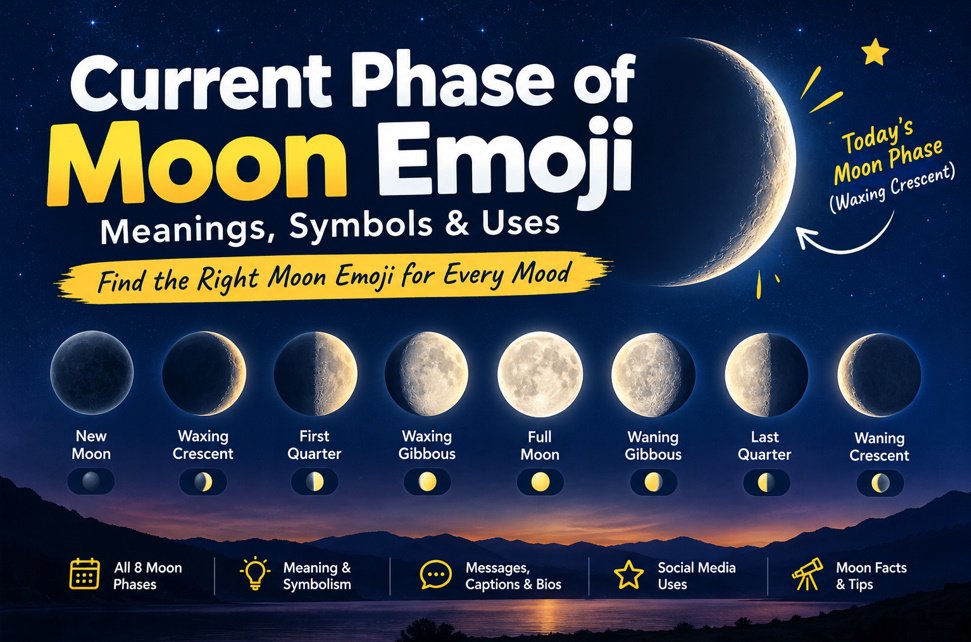
The Moon passes through several phases during its approximately 29.5-day lunar cycle. These include the new moon, waxing crescent, first quarter, waxing gibbous, full moon, waning gibbous, last quarter, and waning crescent. Different moon emojis represent these stages, making it easier to communicate lunar changes through simple, recognizable characters.
- 🌑 New moon
- 🌒 Waxing crescent
- 🌓 First quarter
- 🌔 Waxing gibbous
- 🌕 Full moon
- 🌖 Waning gibbous
- 🌗 Last quarter
- 🌘 Waning crescent
Understanding the Eight Moon Phase Emojis
Each moon phase emoji represents a different stage of the lunar cycle. The 🌑 new moon emoji shows a dark Moon, while 🌒 represents a thin illuminated crescent. The 🌓 first quarter emoji displays a half-lit Moon, and 🌔 illustrates a Moon that is more than half illuminated.
The 🌕 full moon emoji represents the fully illuminated lunar disk as seen from Earth. After the full moon, the illuminated portion gradually decreases, producing the 🌖 waning gibbous, 🌗 last quarter, and 🌘 waning crescent phases. Understanding these symbols helps users select an appropriate emoji for astronomy posts, educational content, and everyday conversations.
- 🌑 Dark lunar disk
- 🌒 Growing crescent
- 🌓 Half-lit appearance
- 🌔 Nearly full Moon
- 🌕 Fully illuminated disk
- 🌖 Shrinking gibbous Moon
- 🌗 Half-lit waning Moon
- 🌘 Thin waning crescent
How to Find the Current Moon Phase
To identify the current moon phase, check a reliable lunar calendar or astronomy application that displays the Moon’s phase for your location and date. These resources calculate the lunar cycle and may provide moonrise times, moonset times, illumination percentages, and upcoming full moon dates.
Remember that the current moon phase depends on the date and time, while the emoji is simply a visual representation. The exact appearance of the Moon can also vary with location, weather, and viewing conditions. For accurate results, compare a current lunar calendar with the available moon phase emoji that most closely matches the Moon’s appearance.
- Check today’s lunar calendar.
- Confirm your local date.
- Review the Moon’s illumination.
- Look up moonrise and moonset.
- Check the next full moon.
- Identify the current lunar stage.
- Match the stage to an emoji.
- Update time-sensitive blog content.
Moon Emoji Meanings in Text Messages
Moon emojis can communicate more than astronomy. In everyday messages, 🌙 often represents nighttime, peaceful feelings, bedtime, or a good-night greeting. The 🌕 full moon emoji may suggest brightness, mystery, or a beautiful night sky, while 🌑 can create a darker, more mysterious atmosphere in a caption.
The meaning depends on the conversation and the person using the symbol. Some people use moon emojis for aesthetic decoration, while others include them in messages about stargazing, nature, relaxation, or sleep. Choosing the right moon emoji helps make a message more expressive without requiring additional words.
- 🌙 Good-night messages
- 🌕 Bright nighttime scenes
- 🌑 Mysterious moods
- 🌒 New beginnings
- 🌗 Changing circumstances
- 🌘 Quiet evenings
- ✨ Magical aesthetics
- 🌌 Stargazing conversations
Best Moon Emojis for Social Media Captions
Moon phase emojis are useful for Instagram captions, TikTok descriptions, Facebook posts, WhatsApp statuses, and other digital content. They add visual interest to posts about astronomy, night photography, moon watching, celestial events, and peaceful evening routines. Pairing a moon emoji with a short caption can make a post feel more personal and visually appealing.
For educational accounts and astronomy blogs, use a moon emoji that matches the lunar stage being discussed. For lifestyle content, 🌙 and 🌌 may suit nighttime themes, while 🌕 works well for full moon photography. If your caption describes the actual Moon, verify its current phase instead of choosing a symbol based only on appearance or aesthetic preference.
- 🌑 New moon night
- 🌒 A little lunar magic
- 🌓 Halfway to the full moon
- 🌔 Moonlit moments
- 🌕 Full moon glow
- 🌖 Lunar changes
- 🌗 A different perspective
- 🌘 Quiet skies
Difference Between Moon Phase Emojis and the Moon Emoji
The eight moon phase emojis specifically represent the changing illuminated appearance of the Moon throughout its lunar cycle. In contrast, 🌙 is a crescent moon symbol commonly used to represent nighttime, sleep, or a celestial theme. These symbols are related, but they do not always serve the same purpose in digital communication.
When writing about the current lunar phase, select one of the phase-specific symbols that most closely matches the observed stage. When creating a general nighttime greeting or decorative caption, 🌙 may be a better choice. Knowing the difference makes your content clearer and helps readers understand whether you mean the actual lunar phase or simply the idea of nighttime.
- 🌑–🌘 Represent lunar phases.
- 🌙 Commonly represents nighttime.
- 🌕 Illustrates a full moon.
- 🌒 Shows a waxing crescent.
- 🌘 Shows a waning crescent.
- 🌌 Represents the night sky.
- ✨ Adds a celestial accent.
- 🌠 Suggests a shooting star.
How to Copy and Use Moon Phase Emojis
Copying moon phase emojis is straightforward on most modern devices. You can select a symbol from this article and paste it into a text message, social media caption, document, blog post, or calendar entry. Most current smartphones, tablets, and computers support these Unicode emoji characters, although their appearance may vary across operating systems and applications.
For better readability, avoid placing too many emojis together in a single sentence. Choose a symbol that fits the context, especially when publishing educational or astronomy-related content. If you are writing about the current moon phase, make sure the text and emoji describe the same lunar stage so readers receive consistent information.
- Select your preferred moon emoji.
- Copy the symbol.
- Open your target application.
- Paste it into your text.
- Add a relevant caption.
- Check the displayed appearance.
- Verify the lunar phase if needed.
- Publish or send your message.
SEO Tips for Writing About Current Moon Phase Emojis
A well-optimized article about the current phase of moon emoji should answer the reader’s main question quickly and explain the meaning of each relevant symbol. Include related terms naturally, such as moon phase symbols, lunar cycle emojis, current lunar phase, full moon emoji, new moon symbol, waxing crescent, waning crescent, and moon emoji meanings.
For improved visibility in traditional search engines and AI-powered search results, use descriptive headings, short paragraphs, informative lists, and accurate explanations. Avoid repeating the primary keyword unnaturally. If the article claims to show the current lunar phase, update it with date-specific information from a reliable lunar calendar and clearly distinguish the astronomical phase from the emoji used to represent it.
- Use the main keyword naturally.
- Explain all eight lunar phases.
- Include related semantic keywords.
- Write clear, descriptive headings.
- Answer common reader questions.
- Keep paragraphs concise and useful.
- Verify date-sensitive lunar information.
- Update content when necessary.
Current moon phase example: On October 14, 2026, the Moon is in the waxing crescent phase in Pakistan, represented by 🌒. Its illuminated portion is increasing as it moves toward the first quarter. The exact illumination varies with location and observation time.