
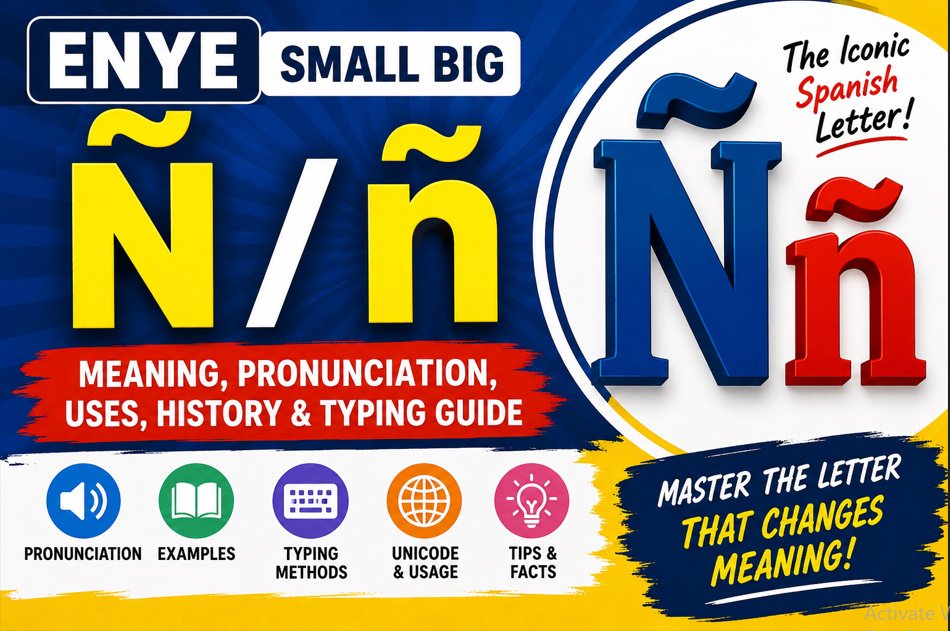
Enye Small Big Ñ / ñ: Complete Guide to the Spanish Letter
The Enye Small Big Ñ / ñ is one of the most recognizable letters in the Spanish alphabet. Unlike the standard letter N, the letter Ñ includes a small wavy mark called a tilde, giving it a completely different pronunciation and meaning. It appears in thousands of Spanish words and is considered a separate letter rather than a modified version of N.
Whether you are learning Spanish, creating educational content, typing international names, or simply curious about special characters, understanding Enye Small Big Ñ / ñ is extremely useful. This guide explains its history, pronunciation, keyboard shortcuts, practical uses, and interesting facts in simple language.
What Is Enye Small Big Ñ / ñ?
The letter Ñ is the uppercase version, while ñ is the lowercase version of the same letter. Together, they are commonly called the Enye because of their pronunciation in Spanish.
The Enye is officially recognized as a separate alphabet letter in Spanish. It is not merely a decorated N. Replacing Ñ with N often changes the entire meaning of a word, making correct usage very important in writing and communication.
Key Points
- Ñ is uppercase Enye.
- ñ is lowercase Enye.
- It is part of the Spanish alphabet.
- It has its own pronunciation.
- It is different from the English letter N.
- Thousands of Spanish words use Ñ.
- It appears in personal names.
- It appears in city names.
- It is supported by Unicode.
- It is recognized internationally.
History of the Letter Ñ
The history of the Enye dates back to the Middle Ages. Medieval Spanish scribes often wrote a small “n” above another “n” to save writing space when copying manuscripts. Over time, this small letter gradually transformed into the familiar tilde (~) seen today.
As the Spanish language developed, the symbol became standardized and officially adopted as its own alphabet letter. Today, the Enye represents Spanish culture and is recognized around the world as one of the language’s most iconic symbols.
Key Points
- Originated during the Middle Ages.
- Created by Spanish scribes.
- Saved space in handwritten texts.
- Developed from double N.
- Tilde replaced the second N.
- Became officially standardized.
- Represents Spanish heritage.
- Used for centuries.
- Protected by language authorities.
- Recognized worldwide.
How to Pronounce Enye Small Big Ñ / ñ
The pronunciation of Ñ is similar to the “ny” sound heard in the English word “canyon,” although the Spanish pronunciation is smoother and more natural. It creates a soft nasal sound that is unique within the language.
Learning the pronunciation is important because changing Ñ into N completely changes many Spanish words. Native speakers immediately recognize the difference, making correct pronunciation essential for clear communication.
Key Points
- Sounds like “ny.”
- Similar to “canyon.”
- Different from regular N.
- Common in Spanish vocabulary.
- Easy with regular practice.
- Used in names.
- Used in everyday conversations.
- Important for pronunciation accuracy.
- Helps improve fluency.
- Changes word meanings.
Common Words That Use Ñ
Many everyday Spanish words contain the Enye. These words are used in schools, homes, businesses, travel, and conversations. Knowing these examples helps learners quickly recognize the letter during reading and writing.
Some well-known examples include niño, niña, mañana, señor, señora, español, año, and baño. These words demonstrate how frequently the Enye appears throughout the Spanish language.
Key Points
- Niño (boy)
- Niña (girl)
- Año (year)
- Mañana (tomorrow)
- Señor (Mr.)
- Señora (Mrs.)
- Español (Spanish)
- Baño (bathroom)
- Sueño (dream)
- Piñata
How to Type Enye Small Big Ñ / ñ
Typing the Enye has become very simple because almost every operating system and smartphone includes built-in keyboard support. Whether you use Windows, Mac, Android, or iPhone, several quick methods are available.
You can also use online character generators or copy-and-paste tools whenever your keyboard does not include Spanish characters. These tools save time and ensure accurate spelling in documents, emails, and social media posts.
Key Points
- Windows Alt codes.
- Mac Option shortcuts.
- Spanish keyboard layout.
- Android long-press keyboard.
- iPhone long-press keyboard.
- Unicode support.
- HTML entity support.
- Copy and paste option.
- Online generators available.
- Works across modern browsers.
Where Is Ñ Used?
Although Ñ is most famous in Spanish, it also appears in several other languages influenced by Spanish or using Latin-based alphabets. It is found in books, newspapers, educational materials, official documents, and websites.
The letter is also common in maps, passports, government records, language-learning platforms, dictionaries, and international databases where accurate spelling of names is essential.
Key Points
- Spanish language.
- Filipino languages.
- Personal names.
- Geographic locations.
- School textbooks.
- Government records.
- Passports.
- Websites.
- Dictionaries.
- Educational software.
Unicode and Digital Encoding of Ñ
Modern computers represent every character using Unicode, ensuring that special letters like Ñ display correctly across different devices and operating systems. This universal standard keeps text consistent worldwide.
Developers, designers, and website owners frequently use Unicode and HTML entities when building multilingual websites. Proper encoding prevents display errors and preserves the correct appearance of the Enye.
Key Points
- Unicode supports Ñ.
- Unicode supports ñ.
- HTML entities available.
- UTF-8 compatible.
- Used in programming.
- Used in databases.
- Supports multilingual websites.
- Prevents encoding errors.
- Cross-platform compatibility.
- Essential for international content.
Why Enye Small Big Ñ / ñ Is Important
The Enye is much more than a special character. It represents the identity of the Spanish language and preserves the correct pronunciation and meaning of thousands of words. Without it, many words would become confusing or incorrect.
For students, teachers, translators, developers, travelers, and language enthusiasts, understanding Enye Small Big Ñ / ñ improves communication, writing accuracy, and appreciation of Spanish culture. Learning how to type and use this letter correctly is a valuable digital and linguistic skill.
Key Points
- Represents Spanish identity.
- Improves spelling accuracy.
- Preserves word meanings.
- Supports language learning.
- Useful for students.
- Helpful for teachers.
- Important for translators.
- Valuable for developers.
- Needed for international communication.
- Easy to learn and use.
Conclusion
The Enye Small Big Ñ / ñ is one of the most distinctive letters in the world. From its fascinating medieval history to its everyday use in Spanish vocabulary, it plays a vital role in accurate communication. Learning its pronunciation, typing methods, Unicode support, and practical applications helps anyone working with Spanish text or multilingual content.
Mastering the Enye is a small step that makes a big difference. Whether you are studying Spanish, creating websites, writing documents, or simply expanding your language skills, knowing how to use Ñ and ñ correctly ensures your writing remains accurate, professional, and culturally respectful.